

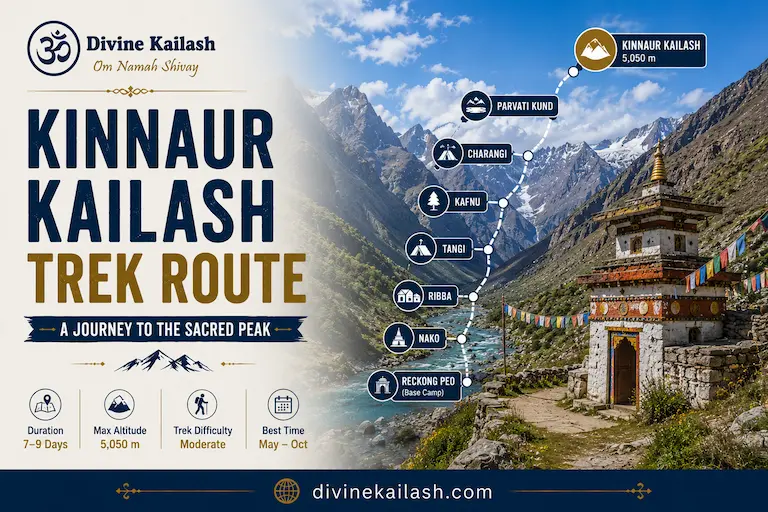
Tucked away in the Trans Himalayan belt of Himachal Pradesh, Kinnaur Kailash is one of the most sacred yet lesser known Shiva pilgrimages in India. Unlike the more crowded Char Dham circuit, this trek takes you into a remote corner of Kinnaur district, where a naturally formed 79 foot rock pillar is believed to be Lord Shiva himself. For anyone researching the Kinnaur Kailash trek route for the first time, this guide covers everything from distance and cost to the official 2026 opening dates.
What Is the Kinnaur Kailash Trek?
Kinnaur Kailash is a Himalayan peak standing at roughly 6,050 meters in the Kalpa region of Kinnaur district, close to the Indo Tibetan border. The trek does not take pilgrims to the actual summit, which requires technical mountaineering skills. Instead, it leads to a striking natural rock formation known as the Shivling, sitting at an altitude of around 4,800 meters. This 79 foot vertical rock is said to change color through the day, appearing golden at dawn, brightening by noon, and taking on deep reddish tones at sunset. Locals and devotees consider this shifting color a divine phenomenon connected directly to Lord Shiva’s presence.
According to legend, Kinnaur Kailash is considered one of Shiva’s sacred abodes, and the region is also where the mythical Kinnaras, celestial beings mentioned in Sanskrit literature, are said to have lived. The trek blends Hindu devotion with strong Tibetan Buddhist influence, since Kinnaur sits right at the cultural crossroads of both traditions.
Kinnaur Kailash Trek Starting Point
The official starting point of the trek is Tangling village, a small settlement on the banks of the Sutlej river, located just a short drive from Reckong Peo, the administrative headquarters of Kinnaur district. Most pilgrims first reach Reckong Peo or the nearby town of Kalpa, spend a night or two acclimatizing, and then take a short drive down to Tangling to begin the actual trek.
From Tangling, the trail climbs steadily through forests and meadows towards a campsite known as Ganesh Park, named after a rock formation resembling Lord Ganesha. From there, the route continues past a natural cave shelter called Gufa, then onward to Parvati Kund, a sacred high altitude lake believed to have been created by Goddess Parvati herself, before finally reaching the base of the Shivling.
Kinnaur Kailash Trek Route Explained
The most commonly followed route runs like this: Tangling village to Ganesh Park, then Ganesh Park to Gufa and Parvati Kund, and finally the last stretch up to the Kinnaur Kailash Shivling. Pilgrims return along the same trail rather than taking a separate descent path, since the alternative route through Charang La pass is longer, more technical, and rarely used for the religious yatra.
A typical six day itinerary looks something like this. Day one covers the drive to Reckong Peo along with acclimatization and a visit to Kalpa for views of the Kinnaur Kailash range. Day two involves a short drive to Tangling followed by the first major trekking stretch up to Ganesh Park, which takes six to seven hours through steep forested terrain. Day three is typically kept as a buffer or short acclimatization walk near Ganesh Park. Day four is the most demanding day of the entire yatra, covering the stretch from Ganesh Park through Gufa and Parvati Kund up to the Shivling itself, followed by descent back to Ganesh Park. Day five is the return trek down to Tangling. Day six covers the long drive back towards Shimla or Chandigarh.
There are a couple of alternative approach routes as well, including paths via Ribba village and Purbani village, though the Tangling route remains the most established and widely used by both pilgrims and trekking operators.
Kinner Kailash Trek Distance
The total trekking distance from Tangling village to the Shivling and back is approximately 25 to 30 kilometers round trip, though this can vary slightly depending on the exact trail conditions and the route taken. Some alternative approach points, such as Powari, add a few extra kilometers to the one way stretch.
Breaking it down by stage, the climb from Tangling to Ganesh Park covers around 8 to 10 kilometers of steep ascent through forest and rocky terrain. From Ganesh Park, the trail continues another 6 to 8 kilometers through Gufa and Parvati Kund before the final 3 kilometer push to the Shivling. Altitude gain across this stretch is dramatic, moving from around 3,800 meters at Ganesh Park to 4,800 meters at the Shivling, which is what makes the distance feel far more demanding than the raw kilometer count suggests.
Kinnaur Kailash Trek Route from Delhi
Pilgrims traveling from Delhi typically route through Chandigarh rather than driving all the way through the hills themselves. From Delhi, it is roughly a five to six hour drive to Chandigarh, where most tour operators arrange pickup. From Chandigarh, the drive to Reckong Peo covers approximately 410 kilometers and takes around 12 to 13 hours along the scenic Hindustan Tibet road, passing through Shimla, Narkanda, Rampur, and the dramatic gorges of the Sutlej valley.
Alternatively, travelers can fly or take a train to Shimla first, then continue by road. The Shimla to Reckong Peo stretch alone covers about 225 kilometers and takes 8 to 10 hours. Given the total distance and mountain roads involved, most itineraries break the Delhi to Reckong Peo journey into two travel days, with an overnight halt in Shimla or a direct long drive from Chandigarh.
Shimla’s Jubbarhatti airport has limited flight connectivity, so Chandigarh airport is the more practical option for pilgrims flying in from other parts of the country. By rail, Kalka railway station on the broad gauge network, or the narrow gauge Shimla railway station, are the closest convenient railheads before continuing onward by road.
Kinner Kailash Trek Best Time to Visit
The trekking season for Kinnaur Kailash runs roughly from June to September, with July and August generally considered the most stable months for weather. Snow typically blocks the higher sections of the trail outside this window, and temperatures at Parvati Kund and the Shivling can drop well below freezing even during the trekking season, particularly at night.
It is worth noting that the official religious yatra, regulated by the Kinnaur district administration, usually runs on a narrower schedule than the general trekking window. Trekkers attempting the route outside the official yatra dates should still expect cold nights, unpredictable mountain weather, and limited local support infrastructure.
Kinnaur Kailash Trek Opening Date 2026
For 2026, the Himachal Pradesh government has approved the official Kinnaur Kailash Yatra to run from July 1 to July 30, with a daily cap of 375 pilgrims to protect the fragile high altitude ecosystem along the route. This approval came after consultations between district officials, local Gram Panchayats, and community representatives from villages along the pilgrimage path.
Registration is mandatory for every pilgrim during this official window and is processed through the Sub Divisional Magistrate office in Reckong Peo. Trekkers need a valid photo ID, passport sized photographs, and a medical fitness certificate confirming they are fit for high altitude trekking. Foreign nationals require an additional Inner Line Permit, since parts of Kinnaur fall within a restricted border zone. Given the narrow 30 day window and the pilgrim cap, it is wise to lock in your registration and travel plans well ahead of July 2026 rather than waiting until the last minute.
Kinnaur Kailash Trek Cost
Pricing for the Kinnaur Kailash trek depends on several factors, including group size, choice of accommodation, whether you are traveling from Delhi, Chandigarh, or Shimla, and the level of support staff included, such as guides, porters, and mules for those who need assistance on the steeper stretches.
A transparent, all inclusive package should typically cover transport to and from the base towns, accommodation at Reckong Peo or Kalpa along with tented stays at Ganesh Park, meals throughout the trek, professional trek leaders and local guides, permit processing at the SDM office, and basic safety equipment. Because pricing shifts from year to year based on fuel costs, accommodation rates, and batch sizes, it is best to request a direct quote for your specific travel dates rather than relying on outdated figures found online.
How Difficult Is the Kinnaur Kailash Trek?
This is not a trek recommended for absolute beginners. The Kinnaur Kailash trek is widely rated as challenging, involving steep gradients, high altitude gain within a short distance, and rugged, rocky terrain in the upper sections near Parvati Kund and the Shivling. Most experienced operators recommend that trekkers have at least one previous high altitude trek above 3,000 meters before attempting this route.
Acclimatization is critical. Spending at least one full day in Reckong Peo or Kalpa before heading to Tangling significantly reduces the risk of altitude sickness. Symptoms like persistent headache, nausea, or breathlessness should never be ignored, and descending to a lower altitude immediately is always the safest response if symptoms worsen.
Preparing for the Trek
Physical preparation should begin at least six to eight weeks before departure, with a focus on uphill cardio, stair climbing, and building general stamina, ideally while carrying a loaded backpack to simulate trail conditions. Good ankle support trekking boots are essential, since much of the upper trail consists of loose scree and jagged rocks rather than a clear path.
Mobile connectivity becomes unreliable beyond Tangling village, so it helps to download offline maps in advance and inform family members about limited contact during the trek. Reckong Peo is the last point with reliable ATM access, so carrying sufficient cash for the remainder of the journey is a good idea. Warm layered clothing, a reliable water bottle, sun protection, and basic personal medication round out the essential packing list.
Plan Your Kinnaur Kailash Yatra 2026 with Divine Kailash
At Divine Kailash, we specialize in sacred Himalayan pilgrimages, and the Kinnaur Kailash Yatra is one of our most carefully planned itineraries. Our Kinnaur Kailash Yatra 2026 Complete Pilgrimage Package covers the entire journey from Shimla or Chandigarh through Reckong Peo, Kalpa, and Tangling, all the way to the sacred Shivling at Parvati Kund, with every stage handled by experienced local guides.
We manage the complete registration process at the Reckong Peo SDM office on your behalf, including document collection, medical fitness formalities, and Inner Line Permits for foreign nationals, so you never have to navigate government offices on your own. Every batch includes a dedicated acclimatization day, something many operators skip, along with transparent, all inclusive pricing covering transport, accommodation, meals, permits, and safety equipment.
With only a 30 day official yatra window in July 2026 and a strict daily pilgrim cap, spots for this season are limited. Reach out to us at yatra@divinekailash.com or call +91 7795021616 to check available 2026 batch dates, get a personalized cost quote, and begin your journey to one of the most sacred and untouched Shiva pilgrimages in the Himalayas.
Frequently Asked Questions About Kinnaur Kailash Trek Route
1. Where does the Kinnaur Kailash trek start?
The trek officially begins at Tangling village, a short drive from Reckong Peo, the administrative headquarters of Kinnaur district in Himachal Pradesh.
2. What is the total distance of the Kinnaur Kailash trek?
The round trip trekking distance from Tangling village to the Shivling and back is approximately 25 to 30 kilometers, depending on the exact route and trail conditions.
3. What is the Kinnaur Kailash trek route from Delhi?
Pilgrims from Delhi typically travel to Chandigarh first, roughly five to six hours by road, then continue to Reckong Peo, which is about 410 kilometers and 12 to 13 hours further along the Hindustan Tibet road.
4. When does the Kinnaur Kailash Yatra open in 2026?
The Himachal Pradesh government has approved the official Kinnaur Kailash Yatra for 2026 to run from July 1 to July 30, with a daily cap of 375 pilgrims.
5. What is the best time to visit Kinnaur Kailash?
June to September is generally considered the trekking season, with July and August offering the most stable weather. The official yatra window for 2026 falls within this period.
6. How much does the Kinnaur Kailash trek cost?
Cost depends on group size, accommodation choices, and starting location, whether Delhi, Chandigarh, or Shimla. It is best to request a customized quote based on your specific travel dates.
7. How difficult is the Kinnaur Kailash trek?
It is rated as a challenging trek, involving steep ascents, high altitude gain, and rocky terrain. Prior high altitude trekking experience above 3,000 meters is generally recommended.
8. Is registration mandatory for the Kinnaur Kailash Yatra?
Yes, registration is compulsory and processed through the SDM office in Reckong Peo, requiring a valid ID, photographs, and a medical fitness certificate. Foreign nationals also need an Inner Line Permit.
9. What is the altitude of the Kinnaur Kailash Shivling?
The Shivling rock formation sits at approximately 4,800 meters, while the Kinnaur Kailash peak itself rises to around 6,050 meters, though the peak is not part of the pilgrimage trek.
10. How many days does the Kinnaur Kailash trek take?
Most itineraries, including travel time from Shimla or Chandigarh, take around six days in total, covering acclimatization, the trek to the Shivling, and the return journey.