
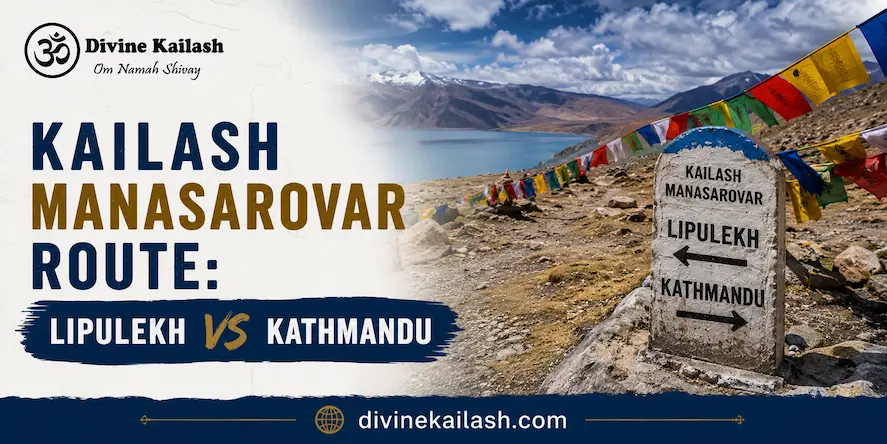
Every year, thousands of pilgrims face the same question before booking their Kailash Mansarovar Yatra: should I go via Lipulekh or through Kathmandu?
Both routes lead to the same sacred destination, Mount Kailash (6,638 m) and Lake Mansarovar (4,590 m) in Tibet’s Ngari prefecture and the Tibet Autonomous Region. But the journey to get there looks completely different depending on which path you take. The distance, duration, physical difficulty, acclimatization, comfort, and cost all vary significantly between the two.
This guide breaks down every factor so you can make the right decision for your fitness level, age, schedule, and budget.
Lipulekh vs Kathmandu: Quick Recommendation
| Choose Lipulekh If…You want the traditional Indian government routeYou have 22-25 days availableYou enjoy high-altitude trekkingYou are physically fit and preparedYou want the deepest Kumaon cultural experience | Choose Kathmandu If…You want a shorter trip (13-16 days)You prefer road travel with minimal trekkingYou are travelling with familyYou are above 60 years oldYou want guaranteed departure without a lotteryYou are an NRI or foreign national |
Step-by-Step Route Map: Lipulekh vs Kathmandu
Here is how each route unfolds from start to Darchen, the base camp for the Kailash Parikrama:
| Lipulekh Route (India) | Kathmandu Route (Nepal) |
|---|---|
| Delhi | Kathmandu |
| Almora / Pithoragarh | Syabrubesi |
| Dharchula | Kerung (Gyirong) Border |
| Gunji (3,200 m) | Gyirong Town |
| Nabhidhang (3,600 m) | Saga (4,640 m) |
| Lipulekh Pass (5,334 m) | Darchen (4,575 m) |
| Taklakot / Burang (3,900 m) | Lake Mansarovar (4,590 m) |
| Lake Mansarovar (4,590 m) | Kailash Parikrama (52 km) |
| Darchen (4,575 m) | |
| Kailash Parikrama (52 km) |
Both routes converge at Darchen (4,575 m). The Kailash Parikrama — 52 km around the mountain, crossing Dolma La Pass at 5,630 m — is the same challenge for everyone regardless of how they arrived.
Full Route Comparison: Lipulekh vs Kathmandu
| Factor | Lipulekh Route | Kathmandu Route |
|---|---|---|
| Starting Point | Delhi, Uttarakhand | Kathmandu, Nepal |
| Entry into Tibet | Lipulekh Pass (5,334 m) | Gyirong / Kerung border |
| Route Operator | MEA / Government of India (ITBP supported) | Private tour operators |
| Total Duration | 22-25 days | 13-16 days (overland) / 10-12 days (helicopter) |
| Approx. Distance (round trip) | ~3,000 km | ~2,000-2,100 km |
| Maximum Altitude on Route | 5,334 m (Lipulekh Pass) | ~4,700 m (Gyirong area) |
| Trekking on Approach | 7-8 km mandatory trek to Lipulekh Pass | Minimal — almost fully motorable |
| Road Conditions | Mix of paved + mountain roads | Paved highway through Tibet |
| Physical Difficulty | Moderate to High | Low to Moderate |
| Selection Process | Government lottery (computerized draw) | Open booking, no lottery |
| Approx. Cost (2025-26) | Rs 1.84 lakh (MEA) | Rs 1.70-2.20 lakh (overland private) |
| AMS / HAPE / HACE Risk | Higher (rapid altitude gain) | Moderate (structured rest stops) |
| Suitable for Senior Citizens | Limited — fitness dependent | Yes, especially helicopter option |
| Suitable for Beginners | With strong preparation | Yes |
| Suitable for NRIs / Foreigners | No (MEA: Indian nationals only) | Yes |
| Best Travel Months | June-September | May-September |
Distance Comparison: India Route vs Nepal Route
| Route Segment | Lipulekh Route | Kathmandu Route |
|---|---|---|
| Total round trip distance | ~3,000 km | ~2,000-2,100 km |
| Kathmandu / Delhi to border crossing | ~860 km (Delhi to Lipulekh Pass) | ~170 km (Kathmandu to Kerung border) |
| Border crossing altitude | 5,334 m (Lipulekh Pass) | ~2,800 m (Gyirong border) |
| Tibet plateau road to Darchen | ~200 km (Taklakot to Darchen via Mansarovar) | ~800-900 km (Gyirong to Darchen via Saga) |
| Mandatory approach trek | 7-8 km (Nabhidhang to Lipulekh) | None (road crossing at Gyirong) |
| Kailash Parikrama (both routes) | 52 km over 3 days | 52 km over 3 days |
| Dolma La Pass (both routes) | 5,630 m | 5,630 m |
The Lipulekh Route: What You Need to Know
The Lipulekh route is the traditional Indian pilgrimage path to Kailash Mansarovar, organized by the Ministry of External Affairs (MEA) since 1981. It starts in Delhi, passes through Almora, Pithoragarh, and Dharchula in Uttarakhand before climbing through the Kumaon Himalayas to Lipulekh Pass at 5,334 m on the India-Tibet border.
The total yatra spans 22 to 25 days. The route passes through some of the most scenic Kumaon Himalayan terrain — the Kali River valley, Gunji village, and the Om Parvat area near Nabhidhang.
There is a mandatory 7 to 8 km trek from Nabhidhang (3,600 m) to the Lipulekh Pass. This is not a casual walk. The altitude gain is steep, oxygen levels drop noticeably, and the trail demands solid physical conditioning. All pilgrims on the MEA route are medically cleared by ITBP personnel — ITBP doctors can turn back any pilgrim showing signs of AMS (Acute Mountain Sickness), HAPE (High Altitude Pulmonary Edema), or HACE (High Altitude Cerebral Edema).
2026 Update: The MEA conducts a computerized draw of lots to select pilgrims. In 2025, with 5,561 applications and only 750 spots available across 15 batches (5 via Lipulekh, 10 via Nathu La), the oversubscription rate was roughly 7 to 1. For the official 2026 schedule and fees, check mea.gov.in.
Advantages of the Lipulekh Route
- Deep cultural immersion through Kumaon Himalayas, passing temple sites like Jageshwar and Patal Bhuvaneshwar
- Government-managed with full ITBP medical support and structured logistics
- Strong gradual acclimatization profile: Dharchula (915 m) → Gunji (3,200 m) → Nabhidhang (3,600 m) → Tibet
- Lower cost — approximately Rs 1.84 lakh per pilgrim under the MEA program (2025 reference)
- The traditional spiritually significant overland path from India into the Tibet Autonomous Region
- Passes through Burang County (Taklakot) for rest and acclimatization before Mansarovar
Challenges of the Lipulekh Route
- Lottery-based selection — no guarantee of a spot even if you are physically fit
- Mandatory 7-8 km high-altitude trek to Lipulekh Pass (5,334 m)
- Long duration of 22-25 days requires extended leave from work
- Accommodation on the Indian side is basic — tents and simple guesthouses in remote terrain
- Only Indian nationals can apply through the MEA Kailash Yatra program
- Oxygen saturation monitoring is mandatory; pilgrims with low SpO2 readings can be turned back at any stage
- Yatra may be suspended during diplomatic tensions between India and China
The Kathmandu Route: What You Need to Know
The Kathmandu route operates through Nepal and Tibet, run entirely by private tour operators. Pilgrims fly to Kathmandu, obtain a Chinese Group Visa (usually processed in Kathmandu), and cross into Tibet via the Gyirong (Kerung) border or — if taking the helicopter option — via Simikot and Hilsa. See Divine Kailash’s Kailash Manasarovar Yatra from Kathmandu page for package details.
Overland option: Kathmandu to Kerung border to Gyirong to Saga to Darchen. Total round trip distance is approximately 2,000 to 2,100 km. Duration is 13 to 16 days. Travel through Tibet is almost entirely by AC bus or Land Cruiser, with acclimatization stops built into the schedule at Gyirong and Saga (4,640 m). The route passes through the Tibet Autonomous Region on well-maintained paved roads — a very different experience from the Lipulekh mountain trail.
Helicopter option: Kathmandu to Nepalgunj to Simikot (flight) to Hilsa (helicopter) to Purang to Mansarovar to Darchen. Duration 10 to 12 days. This is the most comfortable format available, ideal for those who cannot commit to long road travel. See the Kailash Manasarovar Yatra by Helicopter options for details.
One important note for 2025-26: Chinese Group Visa biometrics typically need to be done in person at the Chinese Visa Center in Kathmandu. Plan your arrival in Kathmandu at least 5 to 6 days before departure for visa processing.
Advantages of the Kathmandu Route
- No lottery — guaranteed departure once you book and permits are confirmed
- Much shorter duration: 13-16 days overland or 10-12 days by helicopter
- Almost fully motorable to Darchen — minimal approach trekking outside the Parikrama
- Open to Indian nationals, NRIs, and foreign nationals alike
- Flexible package options from budget overland to premium helicopter
- Structured acclimatization stops at Gyirong and Saga reduce AMS risk when respected
- The Gyirong border crossing sits at a lower altitude (~2,800 m) than Lipulekh (5,334 m)
Challenges of the Kathmandu Route
- Chinese Group Visa requires in-person biometrics in Kathmandu — add 5-6 days for this
- Road through Tibet’s plateau can be dusty, cold, and tiring despite being paved
- Rushing the acclimatization days at Saga increases HACE and HAPE risk significantly
- Private operator quality varies — route experience and on-ground medical support differ widely
- Helicopter option is weather-dependent; fog or storms delay Hilsa legs by a day or more
- Less Himalayan cultural depth compared to the Uttarakhand journey through Kumaon
Acclimatization: Which Route Handles Altitude Better?
Acclimatization is the single most important safety factor on this yatra. Ignoring rest days on either route is the leading cause of pilgrims being turned back before completing the Parikrama.
Lipulekh Route: The gradual climb from Dharchula (915 m) through Gunji (3,200 m) and Nabhidhang (3,600 m) gives your body 5 to 7 days of slow altitude gain before the Lipulekh Pass crossing. ITBP doctors monitor oxygen saturation at each camp. This is one of the most methodical acclimatization profiles available on any Kailash route.
Kathmandu Route: The overland option climbs from Kathmandu (1,400 m) to Kerung border (~2,800 m) to Saga (4,640 m) to Darchen (4,575 m). Good operators build dedicated rest days at Gyirong and Saga. The faster altitude gain compared to Lipulekh makes these rest days non-negotiable. Pilgrims who skip Saga acclimatization are the most likely to suffer AMS or HAPE by the time they reach Darchen.
Regardless of route, watch for AMS symptoms: persistent headache, nausea, loss of appetite, and difficulty sleeping. HACE (confusion, loss of coordination) and HAPE (breathlessness at rest, pink frothy cough) are emergencies requiring immediate descent.
Trekking Distance Comparison
| Trekking Segment | Lipulekh Route | Kathmandu Route |
|---|---|---|
| Trek to border crossing | 7-8 km (Nabhidhang to Lipulekh Pass) | None (road crossing at Gyirong) |
| Road travel in Tibet | ~200 km (Taklakot to Darchen) | ~800-900 km (Gyirong to Darchen) |
| Kailash Parikrama | 52 km over 3 days | 52 km over 3 days |
| Dolma La Pass altitude | 5,630 m | 5,630 m |
| Total approach trekking | ~8 km (plus Parikrama) | Minimal (Parikrama only) |
Which Route Is Better for Senior Citizens?
If you are above 60, or have any history of knee problems, blood pressure issues, or reduced lung capacity, the Kathmandu route is the more suitable choice.
The Lipulekh Pass trek at 5,334 m is genuinely demanding. Even fit pilgrims in their 50s find it challenging. ITBP medical personnel have final authority to turn back any pilgrim showing altitude distress — and they exercise that authority regularly.
The Kathmandu overland option keeps road travel motorable all the way to Darchen. Your biggest physical challenge is the Parikrama itself, for which ponies and porters are available. The helicopter option via Kailash Manasarovar Yatra by Helicopter eliminates multi-day road travel entirely and is the most comfortable option available for senior pilgrims.
Which Route Is Better for First-Time Travellers?
First-timers often underestimate how altitude — not trekking — determines whether they complete this yatra.
If you have never been above 4,000 m before, the Kathmandu overland route is a more forgiving introduction to high-altitude pilgrimage. The road journey through Tibet lets your body adapt gradually without the added demand of the Lipulekh Pass climb on top of the Parikrama.
If you are physically active, have some Himalayan experience, and want the deepest cultural journey from India to Kailash, the Lipulekh route is a powerful and rewarding choice. Go in with clear eyes about the physical requirement and respect every ITBP rest day instruction. The Kailash Manasarovar Yatra by Road page has full package details for this option.
Which Route Is More Scenic?
Both routes are visually extraordinary but offer different kinds of beauty.
The Lipulekh route passes through the Kumaon Himalayas — Kali River valley, dense forests, remote Himalayan villages, and the dramatic high-altitude terrain around Om Parvat and Nabhidhang. This is raw, largely untouched Himalayan landscape with a strong spiritual atmosphere even before you cross into Tibet.
The Kathmandu overland route through Tibet’s plateau showcases wide open skies, ancient monasteries, turquoise lakes including Rakshas Tal near Mansarovar, and the Gyirong Valley’s dramatic shift from green Himalayan forest to the dry golden Tibetan plateau. The road past Saga toward Darchen offers uninterrupted views at altitude that are difficult to find anywhere else on earth.
For photography enthusiasts, the Lipulekh route wins on Kumaon Himalayan scenery. The Kathmandu overland route wins on sheer Tibetan plateau grandeur.
Decision Matrix: Which Route Is Right for You?
| Traveller Type | Recommended Route |
|---|---|
| First-time pilgrim (moderately fit) | Kathmandu overland |
| Senior citizen (above 60) | Kathmandu overland or helicopter |
| Adventure trekker | Lipulekh route |
| Indian pilgrim seeking cultural depth | Lipulekh route |
| Budget-conscious traveller | Lipulekh (MEA) — Rs 1.84 lakh |
| Traveller with limited leave (under 15 days) | Kathmandu overland or helicopter |
| NRI or foreign national | Kathmandu route (MEA not available) |
| Photography enthusiast | Either — different strengths |
| Pilgrim seeking minimum trekking | Kathmandu helicopter option |
| Family group with varied fitness levels | Kathmandu overland |
| High-altitude MEA yatra veteran | Lipulekh or Nathu La |
| Pilgrim who failed MEA lottery | Kathmandu overland as backup |
Common Mistakes People Make When Choosing a Route
Choosing Lipulekh only for cost reasons.
The MEA route is cheaper, but it requires significant physical preparation. If you are not regularly hiking or conditioning at altitude, saving money on the route can cost you the yatra if you are turned back at an ITBP medical checkpoint.
Choosing Kathmandu without vetting the operator.
The Nepal route is unregulated compared to MEA. Operators vary widely in experience, permit handling, on-ground oxygen support, and crisis management. Never book with an operator who cannot share Tibet permit track records and verifiable group feedback.
Underestimating the Parikrama.
Both routes end at the same 52 km Kailash Parikrama crossing Dolma La at 5,630 m. Pilgrims sometimes prepare well for the approach route and forget this is the hardest part regardless of how you arrived.
Rushing acclimatization days.
On both routes, this is the single biggest mistake. The urge to cover distance faster is understandable, but AMS or HAPE at Darchen — or worse, on the Parikrama — can end your yatra completely.
Applying for the MEA lottery without a backup plan.
The Lipulekh lottery has a 7-to-1 rejection rate. If you only apply once and are not selected, you miss the year. Have the Kathmandu route as your parallel option. Divine Kailash offers both — see the full Kailash Manasarovar Yatra to compare what works for your plan.
FAQ: Kailash Mansarovar Route — Lipulekh vs Kathmandu
Which route is best for the Kailash Mansarovar Yatra?
There is no single best route — it depends on your fitness, nationality, available time, and budget. The Lipulekh route suits physically active Indian pilgrims who want the traditional overland MEA Kailash Yatra from India. The Kathmandu route is better for those who want flexibility, shorter duration, and less approach trekking.
Is the Kathmandu route easier than the Lipulekh route?
Yes, the Kathmandu overland route involves far less trekking on the approach leg. The Lipulekh route requires a mandatory 7 to 8 km trek at 5,334 m before entering Tibet. The Kathmandu route is road-based almost entirely to Darchen. Both routes involve the same 52 km Kailash Parikrama and Dolma La Pass crossing at 5,630 m.
Which route has less trekking?
The Kathmandu overland route has the least approach trekking. The helicopter option via Simikot and Hilsa reduces travel time further. The Lipulekh route has a mandatory 7 to 8 km high-altitude pass crossing in addition to the Parikrama.
Which route is better for senior citizens?
The Kathmandu route is generally better for pilgrims above 60. The motorable road through Tibet, combined with the option of helicopter assistance on the Nepal leg, is far more manageable than the Lipulekh trek. For senior pilgrims, the helicopter via Kathmandu to Simikot and Hilsa is the most comfortable format available.
Which route offers better acclimatization?
The Lipulekh route offers a more gradual altitude gain over 5 to 7 days through Uttarakhand’s Kumaon Himalayas before reaching Tibet. The Kathmandu overland route has structured rest stops at Gyirong and Saga. Both can acclimatize you safely if itinerary rest days are not compressed. AMS risk is present on both routes above 4,000 m.
What are the AMS, HAPE, and HACE risks on each route?
Both routes involve altitude above 4,500 m and carry risk of Acute Mountain Sickness (AMS), High Altitude Pulmonary Edema (HAPE), and High Altitude Cerebral Edema (HACE). The Lipulekh route’s rapid ascent to 5,334 m on the pass crossing carries higher early AMS risk. On the Kathmandu route, the jump from Kerung to Saga can trigger AMS if rest days are skipped. Both routes require pilgrims to monitor oxygen saturation and descend immediately if HAPE or HACE symptoms appear.
Which route has the highest completion rate?
The Kathmandu overland route generally sees higher completion rates for first-time pilgrims because there is less approach trekking demand and pilgrims tend to arrive at Darchen in better shape. On the MEA Lipulekh route, ITBP medical teams can turn back pilgrims at any point if altitude distress is detected.
Which route should first-time travellers choose?
First-timers with moderate fitness should start with the Kathmandu overland route. It is more forgiving at altitude, logistics are handled end-to-end by the operator, and there is no lottery uncertainty. Save the Lipulekh route for a second Kailash yatra after you have experience above 4,000 m.
How long does each route take?
The Lipulekh route takes 22 to 25 days from Delhi and back. The Kathmandu overland route takes 13 to 16 days. The helicopter option via Kathmandu takes 10 to 12 days.
Can Indian nationals use the Kathmandu route?
Yes. Indian passport holders can travel to Kailash Mansarovar via Nepal using the Kathmandu route with a valid passport and a Chinese Group Visa. As of 2025-26 regulations, biometrics for the Chinese visa may need to be done in person in Kathmandu. The MEA route via Lipulekh is exclusively available to Indian citizens through the government’s official program.
Final Word
Both routes lead to the same mountain, the same lake, and the same Parikrama. What differs is the path that takes you there.
Choose the route that matches your physical condition honestly — not the one that sounds more adventurous. The Kailash Parikrama is the real test. You want to arrive at Darchen ready for it.
For help choosing the right package for your travel profile, visit the Divine Kailash tour listings to compare current 2026 options across both routes.