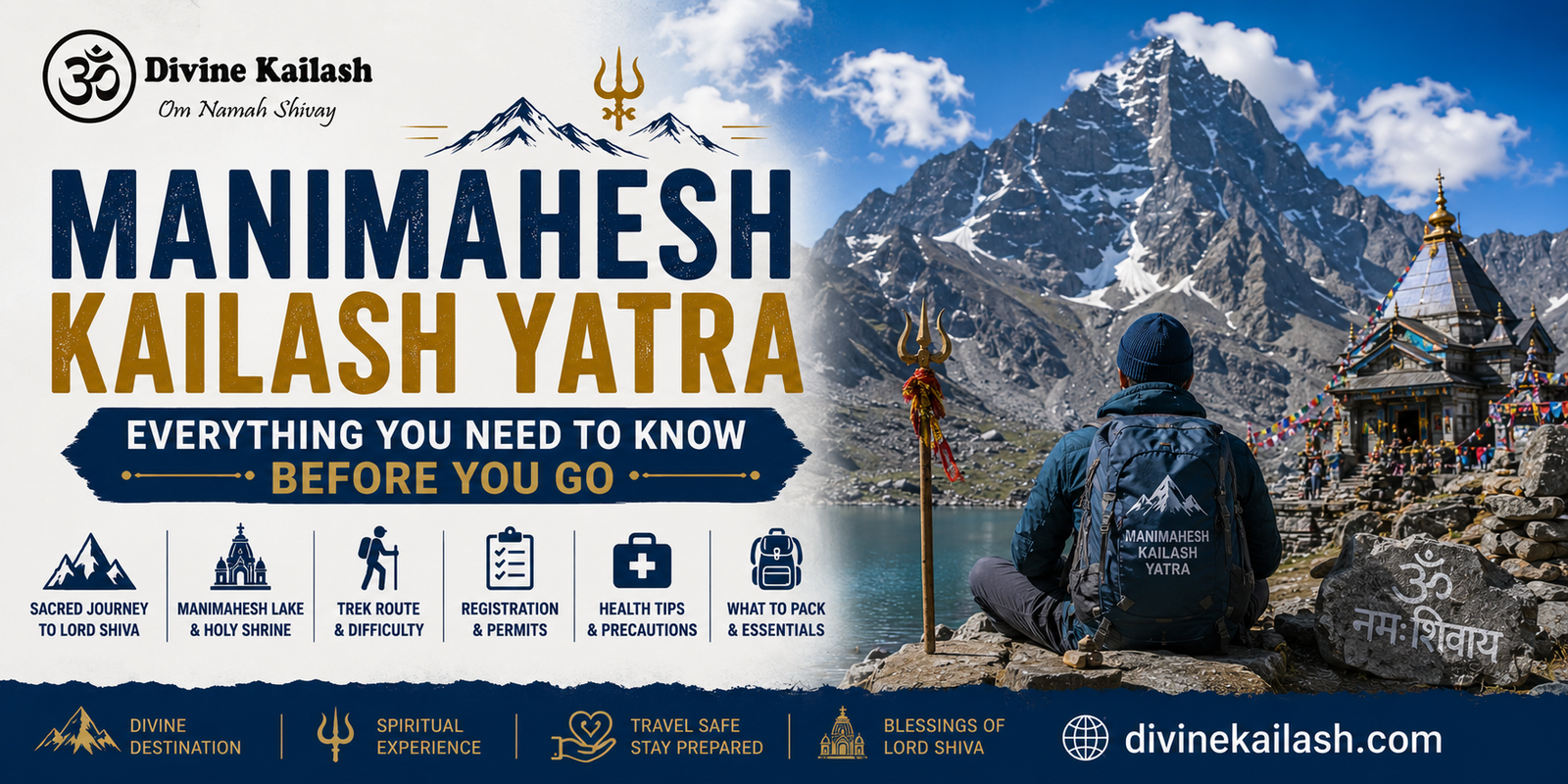
While most pilgrims are familiar with the Kailash Manasarovar Yatra in Tibet, Himachal Pradesh has its own Kailash, the magnificent Manimahesh Kailash peak, and a sacred lake at its base that draws thousands of devotees every year.
The Manimahesh Kailash Yatra is one of the most significant pilgrimages in northern India and is deeply embedded in the religious and cultural fabric of Himachal Pradesh. Yet it remains far less commercialised and far more spiritually intimate than many other major yatras.
If you are planning to undertake this Yatra, this guide covers everything, from its religious significance and trek route to practical information on timing, accommodation, difficulty, and how to get there.
What Is Manimahesh Kailash and Why Is It Sacred?
Manimahesh Kailash (6,528 metres) is a peak in the Pir Panjal range of Himachal Pradesh, located in the Chamba district. It is considered the earthly abode of Lord Shiva. The mountain is named after the jewel (Mani) on Shiva’s necklace.
At the base of this peak lies Manimahesh Lake, also called Dal Lake, situated at an altitude of approximately 4,080 metres. The lake is considered extremely sacred, and taking a dip in its waters is believed to wash away sins and grant moksha.
According to Hindu mythology, Lord Shiva performed the cosmic dance (Tandava) on the peak of Manimahesh Kailash after marrying Goddess Parvati. The lake is said to have formed from the water that dripped from Shiva’s matted hair. The peak reflects on the lake’s surface during certain times of day, a sight that leaves pilgrims speechless.
One distinctive belief associated with Manimahesh Kailash is that no one has ever successfully summited the peak. Every attempt to climb it has reportedly failed, reinforcing the local faith that the mountain belongs entirely to Lord Shiva and cannot be conquered by humans.
Manimahesh Yatra: Religious Significance and the Annual Pilgrimage
The main Manimahesh Yatra takes place during the Bhadrapad Ashtami festival, which falls in August or September according to the Hindu calendar. During this period, hundreds of thousands of pilgrims travel to Manimahesh Lake. The Yatra is inaugurated officially with a religious procession that begins from Bharmour, the ancient capital of Chamba, and from Hadsar village.
The pilgrimage holds importance for Hindus from all traditions. Shaivites, Vaishnavites, and folk traditions of the Gaddi community (the local pastoral people of Chamba) have all been associated with this Yatra for centuries.
Outside the festival season, the trek to Manimahesh Lake is possible from June to October for individual trekkers and small groups.
Manimahesh Yatra Trek Route
The Manimahesh Lake trek can be approached via two routes:
Route 1: Hadsar to Manimahesh Lake (Main Route)
Distance: 13 kilometres one way Starting Point: Hadsar (2,010 metres) Duration: 2 days (one night at Dhancho or camp) Difficulty: Moderate
This is the most commonly used route. The trail passes through the village of Dhancho (3,100 metres), which serves as a major rest stop with basic accommodation and food stalls during the Yatra season. From Dhancho, the trail continues upward through rocky terrain and open alpine ground to reach the lake.
Key points along this route:
- Hadsar village (start point, road accessible)
- Dhancho (mid-point rest area, 3,100 m)
- Shiv Kund (small sacred pond before the lake)
- Manimahesh Lake (4,080 m)
Route 2: Bharmour to Manimahesh Lake (Longer Alternate Route)
Distance: 24 kilometres one way Starting Point: Bharmour (2,195 metres) Duration: 3 to 4 days Difficulty: Moderate to Difficult
This longer route begins from the ancient town of Bharmour, which itself holds a cluster of 84 temples dating back to the 7th to 10th centuries. The route joins the Hadsar trail at Dhancho.
Manimahesh Yatra Difficulty Level
The Manimahesh Lake trek from Hadsar is rated Moderate. It is suitable for reasonably fit individuals with basic trekking experience. The altitude gain is significant (over 2,000 metres from Hadsar to the lake), and the terrain becomes rocky and steep in the final 4 to 5 kilometres.
The trek is not recommended for people with severe heart or lung conditions without prior medical clearance.
First-time trekkers can manage this route comfortably if they are in good general health and have done some walking preparation beforehand.
Best Time to Visit Manimahesh Lake
July to September is the best time for the Manimahesh Kailash Yatra:
- June: The trail opens after snowmelt. Weather is pleasant but early season snow may still be present above Dhancho.
- July to August: Peak pilgrimage season especially around Bhadrapad Ashtami. Trails are busy but well-maintained and stocked with vendors.
- September: Excellent post-monsoon clarity with stunning Himalayan views. Fewer crowds compared to August.
- October onwards: Temperatures drop sharply and snowfall closes the trail by late October.
The lake is completely inaccessible from November to May due to heavy snowfall.
How to Reach Manimahesh: Complete Route from Major Cities
From Delhi: Delhi → Pathankot (by train or bus, approx. 8 to 9 hours) → Chamba (by bus, approx. 5 hours) → Hadsar (by local transport, approx. 2 to 3 hours)
From Chandigarh: Chandigarh → Pathankot → Chamba → Hadsar (total approx. 10 to 12 hours by road)
From Dharamshala: Dharamshala → Chamba (approx. 5 to 6 hours) → Hadsar
The nearest airports are Gaggal Airport (Kangra, 120 km) and Pathankot (for rail connections). Road travel is the primary mode of reaching Hadsar.
Accommodation During Manimahesh Yatra
In Chamba and Bharmour: Multiple hotels and guesthouses are available for all budgets.
At Hadsar: Basic guesthouses and homestays.
At Dhancho: Temporary camps and tent stays are set up during the Yatra season (July to September). Basic food is available.
At Manimahesh Lake: No permanent accommodation exists at the lake. Pilgrims either do a day return from Dhancho or camp near the lake. Portable toilet facilities are set up during peak season.
What to Pack for Manimahesh Yatra
- Warm layered clothing (temperatures at the lake can drop below zero at night)
- Waterproof trekking boots
- Rain jacket and poncho
- Trekking poles (helpful on steep sections)
- Sunscreen SPF 50 and UV sunglasses
- Basic medical kit with altitude sickness medicines
- Sufficient water and snacks for the trail
- Torch or headlamp
- Cash, as no ATMs exist beyond Chamba town
Book Your Manimahesh Kailash Yatra with Divine Kailash
The Manimahesh Kailash Yatra is a deeply moving spiritual experience that deserves to be experienced with the right support and planning. Divine Kailash offers dedicated Manimahesh Kailash Yatra packages for 2026 that cover all transport, accommodation, guide services, and on-ground support from Chamba to the lake.
Their experienced team ensures that your pilgrimage is safe, comfortable, and spiritually fulfilling, whether you are a first-time trekker or a seasoned Himalayan pilgrim. Contact Divine Kailash today to book your Manimahesh Yatra package and take the first step towards this extraordinary journey to the abode of Lord Shiva.